The message in the 7 November 1918 telegram purportedly sent on Captain R. H. Jackson’s order to Admiral H. B. Wilson in Brest, was an ‘afternoon false armistice report’, wired a few hours after similar reports in Paris during the morning. It stated that the [French] Foreign Office had announced an Armistice-signing at 11:00 am, a cessation of hostilities at 2:00 pm, and the US Army’s taking of Sedan that morning. It showed “15207” – 3:20 pm on 7 November – as the transmission time, and “Jackson” as having authorized it.
As the US Army Intelligence Officer in Brest, Arthur Hornblow spent several hours with Roy Howard on 7 November 1918. His Century Magazine feature called ‘Amazing Armistice’,which was based partly on his first-hand knowledge of events in Brest that day, was published in November 1921. Many years later, he received letters from a serving chief petty officer about what had happened in the US Navy Paris Headquarters when the armistice message was sent from there to Admiral Wilson in Brest.
This article begins with what Hornblow learnt about Captain Jackson from Admiral H. B. Wilson in 1921; and then relates what the chief petty officer told him in 1941 and 1944. An ADDENDUM provides some clarifying and other details. (Hornblow’s information here complements that in the article about Roy Howard’s False Armistice findings on this website.)
Information from Admiral Wilson, 1921
Sometime in June or early July 1921, Hornblow sent Admiral Wilson a copy of ‘Fake Armistice’ the original, unpublished version of ‘Amazing Armistice’ – and asked him to comment on it; he also sent it with a similar request to Roy Howard, hoping for their approval of what he had written about them. 1a
Wilson obliged and, replying that he disagreed with “some of [Hornblow’s] facts”, almost immediately referred to the naming of Captain Jackson as the sender of the armistice report. Hornblow had written that Roy Howard told him in Brest that at US Navy Headquarters he and Admiral Wilson “had not been chatting more than a few minutes when an orderly entered with a telegram” around 4:00 pm. And that having read it, Wilson gave it to Howard who “beheld an official communication signed by Commander Jackson, the naval attache at our Paris embassy”, announcing “ARMISTICE SIGNED THIS MORNING AT 11 ALL HOSTILITIES CEASED AT 2 P.M. TODAY”. 1b
Admiral Wilson’s comments on the passage emphasised that:
“[The] message [was] a routine one from my representative in Paris who kept me informed of all reports and rumors. I have never told anyone from whom the message came, other than saying it was from our office there. It is true that one of his functions was Naval Attaché, but those duties were small in comparison with others, and to have the article read that the message was from the Naval Attaché is off, though perhaps technically correct. I feel you do the office of the Naval Attaché an injustice in so expressing yourself. It was from my office in Paris. I hope you see this. I gave it the same credence as the one hundred and one other messages I had received from time to time, some proving correct and some incorrect.” 2 (My italics)
As a result, Hornblow changed the above wording to “Howard beheld an official telegram, signed by Commander Jackson of Admiral Wilson’s office in Paris and naval attache at our Paris embassy.” And in a passage describing Wilson’s acceptance of responsibility for releasing it in Brest, observed that the Admiral “did not even make mention of the official who had sent, or, at least, whose signature was affixed to the erroneous communication from Paris”.(My italics)
When published, ‘Amazing Armistice’ therefore contained several amendments to accommodate comments made about the text of ‘Fake Armistice’ by Admiral Wilson, and also by Roy Howard; in fact, Hornblow chose the new title because Roy Howard persuaded him not to use ‘fake’ to describe the 7 November 1918 armistice news. 3
Information from Moses Cook, 1941 and 1944
In April and May 1941, by which time he was an established Hollywood film producer working at Paramount Pictures, Hornblow received details about how the false armistice news reached US Navy Headquarters in Paris and was transmitted to Brest. They came, unsolicited initially, from Moses Cook, “a press telegrapher in civil life” but then serving as a radio operator with the rank of Chief Petty Officer on the USS Wyoming.
“I . . . sent it originally from Naval Headquarters in Paris”
In April 1941, in his first of four letters to Hornblow, Cook claimed that he was “chief radioman” on duty at US Navy Headquarters in Paris on 7 November 1918. Without elaborating, he stated (ambiguously) that he was “the one who sent it originally from Naval Headquarters in Paris”. As verification, he included a clipping about a Columbia Broadcasting System (CBS) twentieth-anniversary Armistice programme from New York City in November 1938, for which he “told his unique story” (to radio journalist Gabriel Heatter) “of the tense moments when the [false armistice] news was received and how it was cancelled later”. (He did not at first refer to Captain Jackson or the American Embassy.) 4
He had contacted Hornblow, he explained, to request a copy of his November 1921 ‘Amazing Armistice’ to replace one in his collection of “stories relative to this Armistice” which a friend of his (Col. W.H. Rankin) had borrowed while writing a book about Roy Howard but then mislaid.
In his replies to this and Cook’s subsequent letters, Hornblow promised to try to find him a copy of the article, and pressed him for particulars about what had occurred. He asked him for a “recital of . . . facts” about how the “[armistice] telegram was filed with [him] and by whom”; “most particularly”, whether Captain Jackson “had anything to do with [it]”; whether the Embassy had tried “to account for the filing of the wire”; who the officer was who ordered it and why he believed it was authentic; whether “he was an officer of the regular navy or the Reserve; and whether Cook saw him again. Fundamental questions whose answers Hornblow apparently hoped would clear up some of the mystery surrounding the False Armistice.
The following recounts what Cook recalled, and contains extracts from a newspaper item he also sent to Hornblow.
“Very glad to . . . pass along the story of the ‘False Armistice’ to you as it really happened.”
Cook remarked that, apart from himself, only two other people “knew this story”: “a successful attorney in New York City”, whom he did not name; and “Lieutenant Junior Grade Barler”, Navy Reserve, from Michigan, whose initials he did not recall, and who had died in 1934.
On 7 November 1918, Cook was the “chief radioman in charge of the wire room” [Naval Communication area] at US Navy Headquarters in Paris; Lieutenant Barler was the duty “communication officer”. Sometime in the afternoon [no time specified], Barler suddenly rushed into the wire room, handed Cook the message “Armistice signed eleven am, cease firing two pm, Sedan capitulated“, with Captain Jackson’s name on it, and told him “Get this off right away”.
Cook asked the Lieutenant where it had come from; Barler replied that a commander at the Embassy had just telephoned it to him and mentioned his name to Cook (who remembered the commander but not his name). Cook then passed the message to the “operator who was sitting on the Brest Wire” (unnamed), who stopped what he was doing (“sending the American casualty list of the killed and wounded as we did every afternoon”) and forwarded the bulletin straight away.
Some twenty minutes later, Barler rushed back and shouted to Cook “For Gods sake stop that message . . . . Its a fake”. Cook pushed the operator away from the transmitter, “grabbed the key and asked Brest if they could stop the message”. But it was too late –“Brest told [him] it had gone to Washington long ago”.
Cook pointed out that as well as being American Naval Attaché in Paris, Captain Jackson was Commanding Officer at Navy Headquarters. He was “very certain that [Jackson] knew nothing about this message” and did not authorize it even though his name was attached to it: “all messages leaving our headquarters had to be signed ‘Jackson’ as a matter of routine, but he did not see every dispatch that was sent”. Indeed, “he was very much upset about it”, demanded to know what had happened and who had released it, and had Lieutenant Barler “on the carpet about it”.
Years later, just prior to Cook’s participation in the November 1938 CBS Armistice anniversary programme, CBS asked Jackson, by now an admiral, for permission to name him in connection with the False Armistice. He emphatically refused, threatening to “bring suit” against CBS if they did. Consequently, the programme referred to him only by his title of naval attaché. “I am very certain”, Cook maintained, “that he knew nothing about this message”.
Cook was convinced that Lieutenant Barler was duped into thinking the call was from the Embassy when it was “probably the work of an enemy agent” aiming “to give the world a taste of what an Armistice was like and it seems that they did a good job of it . . . . The fault was with the Lieut. How in the world did he fall for a thing like that over the fone?” He was “sent home”, and Cook did not see him again after 7 November. “He simply believed that the telephone call was genuine”.
As soon as Barler mentioned the Embassy, Cook’s suspicions were aroused; he wanted to emphasise that they “never foned that message”, “knew nothing of it, and were never able to locate the party that did . . . . I have never heard of anyone coming forward and saying that they were the one who foned that message to Naval Headquarters”. And why, he wondered, would they “fone such an important message? Why did’nt they put it in code? They coded other messages of less importance, and why was’nt it delivered by a marine courier as were all messages of any urgency? The American Embassy was right behind the Navy Headquarters building. Also I did’nt believe that the Germans had met Foch so soon and to have talked things over so quickly”.
Cook remembered that Lieutenant Barler was subsequently “sent home”, and did not see him again after 7 November; “he simply believed that the telephone call was genuine”. Cook was posted to Italy for a month following the Real Armistice, then to Brest for about seven weeks; here he was “put in charge of the brig” before returning to the United States. Writing again in 1944, by which time he was a warrant officer and “chief radio electrician at the Miami Naval Air station, Opa Locka”, Cook sent Hornblow a cutting about himself from the Miami Daily News with the title ‘Inside Story of False Armistice Flash In 1918 Told By Navy Man Here’. In his interview, Cook had repeated what he related to Hornblow about 7 November events at Paris Navy Headquarters but with an additional conjecture about the origin of the armistice message:
“That will probably always remain a mystery, Cook says. It has been well established that it did not originate in the American embassy. Cook’s own theory is that a clever German agent ‘phoned in the message to the communications system, imitating the voice of [a] commander, who, [Barler] said, dictated [it] to him [from the embassy].”
Cook’s “own theory” that the peace news was German disinformation echoed what Hornblow had surmised in ‘Amazing Armistice’ and may well have been indebted to it. His proposition that a clever German agent imitated the voice of a commander at the Embassy, thereby fooling Lieutenant Barler at Navy Headquarters, quite possibly struck Hornblow as being obviously contrived and comically implausible.
In a brief acknowledgment – the last of their correspondence in the archive – Hornblow thanked Cook for the “interesting clippings on [the] Armistice dispatch”. He was “glad to have them” for his files, and to learn that Cook was “still well and active in the service”. (Whether he ever sent Cook a copy of ‘Amazing Armistice’ is not indicated in their correspondence.) 5
ADDENDUM
Clarifications and other details
Captain R.H. Jackson
Captain Jackson was sent to Paris in June 1917 as the “Representative of the United States Navy Department”, “senior United States Naval Officer on shore in France”, commander of US “naval and aviation bases” in France, and commanding officer at the US Navy Headquarters in Paris. In these capacities, he acted under instructions from Vice-Admiral William S. Sims, the Commander of US Naval Forces in European Waters whose headquarters were in London. He was also Sims’ liaison officer at the French Ministry of Marine in Paris, and was directed to “confer” with Admiral H. B. Wilson at US Navy Headquarters in Brest when (late October 1917) the latter became “Senior Naval Officer afloat in French Waters”.
Lieutenant Commander W. R. Sayles had been the American Naval Attaché since 1915, but he was promoted in January 1918 to the new post of “Intelligence Officer of the United States Naval Forces in France”. Retaining his other responsibilities, Jackson was made Naval Attaché in June 1918 and “Liaison Officer between [Admiral Wilson in Brest] and the French Authorities in Paris”. As Wilson’s Liaison Officer, he was considered to be a member of Wilson’s own staff – there was “considerable official and semi-official” daily communication between Brest Navy Headquarters and what Admiral Wilson called his “office in Paris” 6a
Moses Cook explained to Hornblow that Jackson was “in command of the US Naval Headquarters in Paris and as such was the American Naval Attache there . . . . He was referred to as Commander at times because he was Commanding Officer, but he was above a Commander”. Throughout his time in Paris, Jackson’s office and base was in the US Navy Headquarters building not far from the Embassy. As the new Naval Attaché, his official base and offices were in the Embassy; but he delegated the Assistant Naval Attaché (since October 1917), Lieutenant Commander Charles O. Mass, to carry out his duties there. 6b
Cook’s opinion (above) that Captain Jackson did not know about the armistice bulletin before it went out appears to substantiate Admiral Wilson’s 1921 comments to Hornblow that the statement in Fake Armistice that the Naval Attaché sent it was “off, though perhaps technically correct . . . . It was from my office in Paris. I hope you see this”. And these comments become clearer if, perhaps, someone in the Naval Attaché’s office in the Embassy sent it to Jackson’s Navy Headquarters office, and someone there, in Jackson’s absence, decided it should go to Brest with his name as authorization. 6c
Moses Cook
No particulars about Moses Cook’s first and second world war service in the US Navy have so far been located from official military publications. As he was not a commissioned or warrant officer, no ‘Moses Cook, chief radioman’ is shown, for instance, in the 1918, 1919, or 1941 US Navy Lists. The information about him here is solely from the letters and clippings he sent to Arthur Hornblow.
Lieutenant Barler
According to Cook, Lieutenant Barler wrote down the false armistice news telephoned from the American Embassy, ordered its transmission to Brest, and about twenty minutes later tried to cancel it; but by then it had already left Brest for the Navy Department in Washington, DC. Cook avoided naming the Lieutenant in his broadcast, in deference to the wishes of Barler’s sister.
The only Lieutenant Barler listed in the US Navy Register for that time is: “Barler, Harold A.C., Lieutenant (j. g.) [junior grade] U.S.N.R.F., born 18 May 1886, enrolled 23 September 1917”.7
The unnamed operator of the Brest Wire
According to Cook, Barler died in 1934, leaving just himself and the operator of the Brest Wire as “the only ones that were present” at the transmission of the false armistice dispatch. He noted that he regularly kept in touch with this man, but did not name him, calling him variously “my friend”, “a successful attorney in New York City”, and “a young sailor, now a prominent New York attorney”. The man was actually Lieutenant Emmett King, who described himself as the “Chief Electrician (Radio)” at Navy Headquarters in Paris. 8
From Internet searches, references to “Emmett King . . . an attorney living in New York” have been located in the transcripts of investigations carried out by the US Senate, shortly following the end of the Second World War, into “Expenditures in the Executive Departments”. Apparently, King took part in a business trip, with two other men, to Paris in July 1945, spoke French, “represented the Albert Verley Co. in New York”, and was advising on the negotiation of contracts with “manufacturers of finished perfumes”. His full name is indexed as “Emmett Miles King”; he was 52 in 1945, and therefore 25 in 1918. 9
King affirmed that he “flashed the [false armistice] message” on 7 November 1918, but did not specify that he was operating the Brest Wire. He said he knew “what caused the whole affair”, and “handled the whole case”. He explained that it was “identically the same as the message that was afterwards published in America to the effect that hostilities had ceased”, and that it was given to him “in plain English” at about 3:50 pm (French time). But he did not say where it came from (the Embassy, French Foreign Ministry, French Ministry of War, for instance) only that it was “absolutely from official channels”; did not reveal whose name it carried as authorization, or to whom and where he “flashed” it. He did disclose that almost immediately afterwards it was taken from him and was “never returned to the files”; that “the whole affair” had been caused by a “government official” (not an American) who was responsible for a foolish mistake which could not be made public. 8
US Navy Headquarters in Brest
Apparently, Moses Cook spent seven weeks in Brest before finally leaving France early in 1919. It is reasonable to assume that he became acquainted there with a wireless operator (not identified) at Admiral Wilson’s Headquarters who, L. B. Mickel told Roy Howard, had copied the Jackson Armistice Telegram. And it is possible that Cook also met Lieutenant J. A. Carey, Admiral Wilson’s secretary, who, Hugh Baillie informed Howard, was offering to sell “the original”. Below is the copy of the armistice telegram L. B. Mickel sent to Roy Howard in August 1919. 8
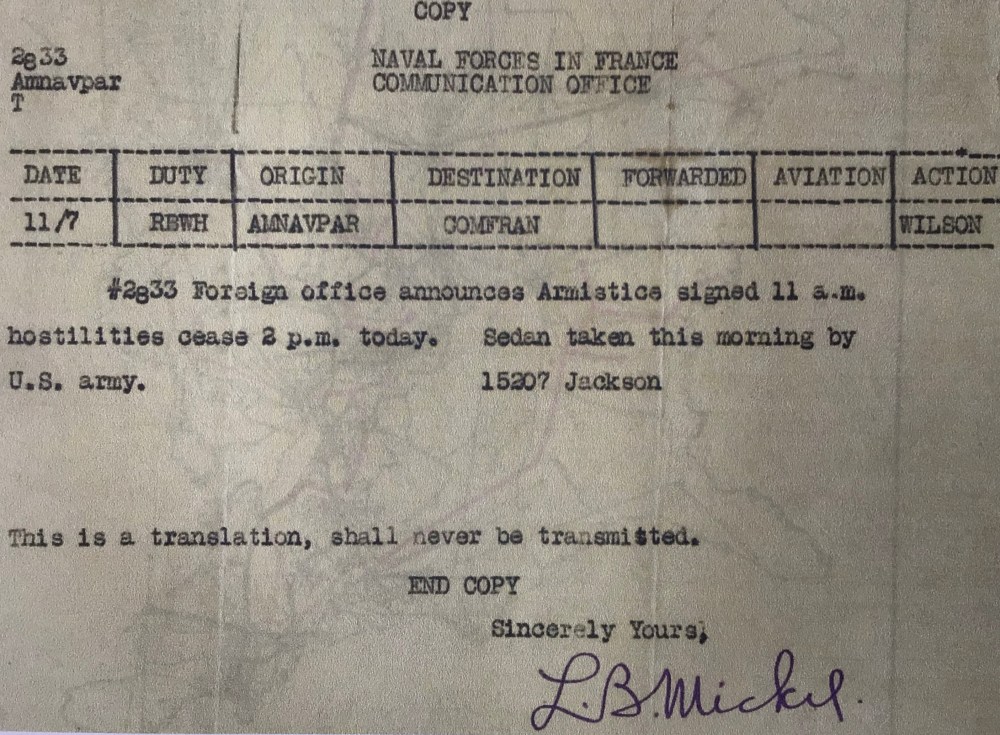
It is not known whether Arthur Hornblow ever saw a telegram version of the Jackson armistice message.
© James Smith. (Reviewed and with additional material, July 2024. Uploaded, reorganized, reviewed, February 2019-March 2026.)
REFERENCES
ARCHIVE SOURCES
I. ‘Arthur and Leonora Hornblow Papers’. Margaret Herrick Library, Academy of Motion Picture Arts and Sciences. Beverly Hills, California.
II. ‘Admiral Henry B. Wilson Papers’, Box 1. Archives Branch, Naval History and Heritage Command, Washington, D.C.
ENDNOTES
1a. ‘Fake Armistice’ is not available in Hornblow’s or Howard’s archives, but the one he sent to Admiral Wilson is preserved in the latter’s papers.
1b. ‘Fake Armistice’, p8. (Admiral Wilson Papers)
2. Admiral Henry B. Wilson to Arthur Hornblow. 13 July 1921 (Sheet 1). (Hornblow Papers; and p2 of Admiral Wilson Papers) Hornblow was the first to state publicly that Captain Jackson sent the armistice message to Brest.
3. ‘The Amazing Armistice: Inside Story of the Premature Peace Report’, in The Century Magazine, November 1921, pp94 and 97.
With clear reasoning Howard pointed out that “Inasmuch as the idea of a fake story involves palpable and deliberate intention to deceive, and inasmuch as your article makes clear that there was no such intention on the part of the newspapers or the newspapermen, I feel that your purpose would be better served and an unintentional injustice avoided by the substitution of another term for the word ‘fake’”. (Roy W. Howard to Arthur Hornblow. San Diego. June nineteenth 1921, p2. Hornblow Papers)
4. First letter: Moses Cook to Arthur Hornblow, 20 April 1941; with a piece about him from The Norfolk Seabag, 2-8-41, under the heading ‘Reserve C.P.O. Had Unique Experience’. (Hornblow Papers)
5. Subsequent correspondence: Arthur Hornblow to Moses Cook, April 28, 1941; Moses Cook to Arthur Hornblow, 7th May, 1941; Arthur Hornblow to Moses Cook, May 14th, 1941; Moses Cook to Arthur Hornblow, May 23, 1941; Moses Cook to Arthur Hornblow (July?) 1944. The latter is not in the collection but is acknowledged in Arthur Hornblow to Moses Cook, 31 July, 1944; its enclosure from The Miami Daily News, 20 June 1944, under the heading ‘Inside Story of False Armistice Flash in 1918 Told by Navy Man Here’ is in the collection. (Hornblow Papers)
6a. See also the ‘Richard H. Jackson. (1866-1971)’ entry in Biographical Details on this website.
6b. Lieutenant Commander Charles O. Maas compiled A History of the Office of the United States Naval Attaché, American Embassy, Paris, France, during the period embraced by the participation of the United States in the war of 1914-1918, for the US Navy’s Historical Section. Many of the details here about Captain Jackson are from this source. Its unbound typewritten pages are held by the US National Archives and Records Service, Washington, DC. (File Unit, E-9-a, 12302. NAID, 196039947 and 196039948, Container ID 745, Record Group 38. The separate typewritten pages appeared as a Print Book in 1977. Maas died in France on 21 July 1919, what must have been a short time after he completed the work. (Brief entry about him in the Columbia University Archives, under Law School, Class Year 1892.) In the Register of the Commissioned and Warrant Officers of the United States Navy, U.S. Naval Reserve Force and Marine Corps, January 1, 1919, pp711;1171, he is listed as “Charles Oscar Maas, born 28 Nov. [18]70. Lieut. Commander U.S.N.R.F. Enrolled, 27 Aug. [19]17.
His History of the Office… is silent about the False Armistice or events in the American Embassy and Navy Headquarters on 7 November 1918.
6c. See ‘The Jackson False Armistice Telegram’ in False Armistice Cablegrams from France on this website.
7. Register of the Commissioned and Warrant Officers of the United States Navy, U.S. Naval Reserve Force and Marine Corps, January 1, 1919, p650.
8. See Roy Howard’s Search for Information about the False Armistice, on this website.
9. Influence In Government Procurement. Hearings Before The Investigations Subcommittee Of The Committee On Expenditures In The Executive Departments. First Session; pp225, 227, 763. (Washington 1949)
 The False Armistice, 7 November 1918