
The False Armistice news that spread on 7 November 1918 to Britain, North and some parts of South America, Australia and New Zealand was transmitted from the French town of Brest, having originated in Paris as the Jackson Armistice Telegram. Arthur Hornblow was a main participant in the False Armistice events in Brest, and wrote an account of them which was published in November 1921. This was the first of only three eyewitness memoirs, the others being by C. Fred Cook, an American army adjutant in Brest in 1918, and by Roy W. Howard himself, the newspaperman responsible for cabling the armistice misinformation from Brest to New York City. Hornblow’s account is below, in the part about his unedited “Fake Armistice” and published “Amazing Armistice” articles. C. Fred Cook’s and Roy W. Howard’s accounts are discussed elsewhere on this website. ENDNOTE 1
Nearly two decades after “Amazing Armistice” appeared in print, what was new information to Hornblow about 7 November 1918 events was given to him by an American navy serviceman – Chief Petty Officer Moses Cook – who had been present when the Jackson Armistice Telegram was wired from Paris to Admiral H. B. Wilson in Brest. The context and content of this fortuitous information follow the “Amazing Armistice” article.
Arthur Hornblow, 1893-1976
In November 1918, Hornblow was the American Army G-2 (SOS) Intelligence Officer for Base Section Number 5 in the French port of Brest on the Brittany Peninsula. He had been enrolled in October 1917 as a second lieutenant (Infantry, National Army) and ordered to report for duty at the Military Intelligence Section of the War College in Washington, DC. He was in France by March 1918, attached to G-2 (SOS) and carried out special duties in Paris, Bordeaux, Biarritz, and Hendaye before being assigned to Brest in June 1918. The following September, he was promoted to first lieutenant.
Shortly after the 11 November Armistice, Hornblow reported to Colonel Cabot Ward, the G-2 (SOS) Assistant Chief of Staff in Paris, “for conference and instructions”. A few days later, by orders from US Army Headquarters in Paris, he was appointed “Conducting Officer, G-2, S.O.S.” at AEF Headquarters in “Neufchateau, St. Mihiel, Verdun, Metz and such other points as may be necessary”. He returned to Paris in December 1918 to take up duties as “Intelligence Officer for the District of Paris” and as a “negative intelligence” officer with the “American Commission to Negotiate Peace” (located in the Hotel Crillon). This work took him through to his discharge from the Army (at his own request) at the beginning of September 1919.
Lieutenant Hornblow was highly regarded by superiors. General G. H. Harries, his commander in Brest, described him as being “100% efficient” but whose “great merit” had gone “without the recognition which promotion should have given him”. Left to Harries, Hornblow would have reached the rank of major.
Colonel Cabot Ward summed up “all [Hornblow’s] service” with G-2 (SOS) as having been “remarkably successful”. With marked “military qualities and loyalty”, Ward observed, he had shown “industry, efficiency, and general ability”, and a “high character and intelligence [that] have made him of great value to the work”.
Colonel R. H. Van Deman, who was in charge of the Office of Negative Intelligence in Paris, considered him to be “a most excellent officer” who had displayed “in a high degree” all the characteristics demanded by the “unusual character” of his department’s work: “exceptional judgment, tact and attention to detail”. In a private letter to Hornblow, the Colonel thanked him for “never [having] been found wanting” and for his contribution to the solving of “many perplexing questions”.
In March 1920, the Adjutant General’s Office of the War Department notified him that the French Government had made him a Chevalier of the ‘Ordre de l’Étoile noire’ (‘Order of the Black Star’) – essentially an award recognising services to the French Empire in Africa. Acknowledging the notification, Hornblow asked for details of his “services rendered” for the decoration, and the ribbon he would be entitled to wear “with civilian clothes”. Surprisingly, he was told there was no citation accompanying his award, and no information about a ribbon. 2
In his official capacity, he met Roy Howard when the latter arrived in Brest on 7 November 1918, and spent several hours with him in the afternoon and evening of 7 November. By this acquaintance Hornblow became an eyewitness to some of the False Armistice events there, but there is no evidence that they met again before Howard left Brest three days later, although, in the circumstances, it would have been unusual had they not done so. During 1921, from his own experience and what he subsequently learnt, Hornblow composed an account of the False Armistice. He called it, initially, the “Fake Armistice”, and was hoping to have it published as a magazine article in time for the third anniversary that year. He sent typewritten copies to Roy Howard, by now Chairman of the Board of the Scripps-McRae Newspapers, and to Admiral Henry B. Wilson, then serving as Superintendent of the US Naval Academy at Annapolis in Maryland. He asked them to comment on what he had written about them and, in effect, consent to its publication. 3 “It’s a good thing apparently that I [did] or fur might have flown!”, he noted in a letter to a friend who had seen Howard’s and Wilson’s responses to his request. 4
The “Fake Armistice” below is reproduced from the copy Hornblow sent to Admiral Wilson, who retained it with other papers relating to himself and the False Armistice. It seems to be the only one still available. 5 It is presented here as a historical document: the original version of what Hornblow knew and intended to say about the events and circumstances of the False Armistice in Brest.
Hornblow’s “Fake Armistice” and “Amazing Armistice”
THE “FAKE ARMISTICE”, An Article by ARTHUR HORNBLOW, Jr. Copy to Admiral Wilson.
I quote from the New York Evening Globe of November 8th, 1918:
“ ‘French troops resumed their advance along the whole front this a.m.’
To-day’s report of military operations quoted above is the best commentary on the greatest and most cruel hoax in the history of journalism, which yesterday deluded not only New York City but every city and town in the country into a delirium of joy by a spurious report from Paris to the effect that an armistice had been effected between Germany and the Allies and that hostilities had ceased. “
Despite the passage of nearly three years, it will not be difficult to recall that astounding November 7th when an allegedly unemotional nation gave the lie to its belittlers by indulging in a demonstration of universal and hysterical gladness, such as the Parisian boulevards, noted for similar exhibitions, have yet to equal!
The inside story of how that historic occurrence came to pass has not, I believe, ever been told, due doubtless to the fact that even to this day scarcely a handful of persons are familiar with that story.
Page 2
Following immediately after the event, there were a great number of erroneous and incomplete explanations in the press, soon lost sight of in the excitement of real armistice days and never again revived or enlarged upon. I feel therefore that the lapse of time has served to mellow interest in the affair, and to warrant my somewhat retrospective narrative. Perhaps what I am able to tell has actually some proper place in the voluminous history of America’s war-time. But, even though oblivion be the fate of my tale, it is none the less a true one and an interesting, [sic] pregnant, as I shall show, with bizarre historical possibilities, and should be told.
The facts necessitate, and I trust I may be pardoned, some brief explanation of my humble place in the proceedings. I had been, for the few months prior to November 7th, 1918, the Army Intelligence Officer of Base Section No.5, the military port area based on Brest. Although on the staff of Brigadier General George H. Harries, commanding the Base, I was also directly responsible to Brigadier General Dennis H. Nolan, chief intelligence officer of the A.E.F. (Assistant Chief of Staff, G-2, G.H.Q.) and to Lieut. Colonel Cabot Ward, chief intelligence officer of the rear, (Assistant Chief of Staff, G-2, S.O.S.). The former was in Chaumont, where General Headquarters were situated; the latter was in Paris, both in constant touch with all information nerve centres.
My duties, in addition to the major one of conducting counter-espionage activities within the Base, called for the reception and care of newspaper correspondents who came to Brest. The reason for this attention was principally one of courtesy, for, although the Intelligence Section of the General Staff is charged by army regulations with the supervision of war correspondents, the Base Intelligence Officers had
Page 3
nothing whatever to do with the censorship of press reports. This task was cared for by a special censorship branch of the Intelligence Section, having officers at Chaumont and Paris, and, it is important to bear in mind that, although Brest is the seat of the French cables and the dispatching point of all messages to the States, no messages of importance could pass by its local censor that had not been approved by the Paris censors.
When, therefore, shortly after the arrival of the rapide [sic] from Paris at nine o’clock on the morning of November 7th, Roy W. Howard’s entrance into Brest was “signalled” by my “gare control” *, I expected to see him shortly thereafter. Most newspaper men made it a point of reporting promptly at the office of the “I.O.” in order to hear if any news had broken locally, and to be facilitated generally in getting around and seeing things and people. I had heard of, but never before met Howard. I knew him to be president of the United Press, an important news association which serves a host of papers all over the world, principally in America. Furthermore, Intelligence instructions as to the status of all correspondents in France which included their standing in the profession and the degree of attention to which they were entitled wherever they went graded Howard among the highest. Hence I looked forward to the call of some one [sic] who very nearly approached the exalted ranking of “distinguished visitor”, a grade of visitor who, having shaken hands with Pershing, usually felt justified in emulating the manners of a German ober-top sergeant in demanding the attention and services of any young officer graded lower than lieutenant colonel.
(* Intelligence operators in civilian clothes posted at the railroad station to “spot” and report the [rest of the text is lost].
Page 4
It was accordingly a matter for surprise and gratification when Howard strolled in casually shortly before noon and disclosed himself to be entitled to that highest form of doughboy decoration, the colorful phrase “regular guy”. Still in his early thirties – or seemingly so – Howard was the typical newspaperman, genial, natural in manner and alert. Slight of build, with something of the college boy still lurking behind his little brush moustache, and a breezy manner that dispelled formality, Howard perched on the edge of my desk and in very short order made me glad he had come.
He laid the immediate groundwork for the staggering occurrence that was to transpire within a few hours by his desire to effect a change in the transportation plans that had been made for him in Paris.
“I’m due to sail at two this afternoon on some ark that takes two weeks getting home,” he lamented. “I’d like to make better speed if possible. Want to catch Prexy Wilson in time to come over here again in his party.”
The man knew even then that Wilson was coming! I sensed something of what goes to make the great newspaper man!
By telephone I learned that the S.S. Leviathan was due to sail the following morning. As it made the trip across in six days or so, Howard could save a week by waiting a day. Accordingly, arrangements were made shifting him from the sailing list of the one ship to the other. That done, we discussed ways and means of his killing time advantageously, and Howard, inspired by some mischievous fate, decided that he would most of all like to meet Admiral Henry B. Wilson, commander of the American navy in French waters, whose headquarters were in Brest.
I suggested strolling around to naval headquarters which were near-by, and we left my office at about noon – it then being what had started to brew for it! As we turned from the Rue du Chateau into the old square – Place du Président Wilson – we paused before the office of Brest’s daily
Page 5
newspaper La Dépêche to examine the bulletin and saw that the Germans had evinced a desire to quit and that their plenipotentiaries were reported to be coming across the lines to sue for an armistice. A small, excited crowd was discussing the tidings and waiting eagerly around for more.
The sight of the Dépêche office inspired Howard to pay it a visit, due to his company’s having relations with it that I was soon to learn. We trapsed inside, and stopped first in the telegraph room, which was nearest the door, and Howard entered animatedly into conversation with the operator on duty in a French that was as utilitarian as it was full of gestures! I gradually gathered a fact that was to have tremendous bearing later on. It seems that there were but two ways of communicating by telegraph between Paris and Brest. One was by the regular wires of the public telegraph service, the other was by the private wire of La Dépêche. Users of the public service – and this included correspondents sending their communications through to be cabled to the States from Brest – had to wait their turn – a matter usually of several hours, and the United Press scored a brilliant mechanical beat by getting the permission of La Dépêche to share its special wire, thereby avoiding delays in transmission to Brest and being able to hop onto the cables ahead of its competitors.
Thus, the system with which United Press communications went through from Paris was as follows: first, it would pass through the necessary censorship, then it would be put on the private Dépêche wire and in this way be sped to Brest. It is highly important to note that the receiving instrument in the Dépêche office is of the ticker-tape variety commonly used throughout France, a
Page 6
machine which typewrites the message as it comes in on paper ribbon. Thus, when the United Press communications were ticked off in the Dépêche office by the Paris operator, the tape bearing the message was cut up and pasted onto the usual telegraphic form and sent by messenger across the Place to the post-and-telegraph office and filed for the cables. Long practise had accustomed the Brest cable censors on duty at the Postes to recognise these United Press messages sent over in this way from the Dépêche office and, in view of their having been already censored in Paris, to give them prompt transmission without further censoring. As will be seen, this habitual treatment of Paris-Dépêche telegrams had great bearing on and is largely accountable for what is to follow.
After Howard had given enthusiastic greetings and remerciements to everbody on the Dépêche staff, we went along to the naval office. I rather expected that Howard would be able to see the Admiral at once. The latter was almost always in his office and exceedingly easy to “get to”. He is one of that small but eminently successful group of executives who, despite the stature of their task, seem always able to see anyone – and for any length of time. Wilson was at that time directing all transport and war activities in French waters, which included, of course, the delicate destroyer operations against enemy submarines and the command of all naval personnel in France. His was a job of enormous responsibility and requiring an inordinate amount of wakeful attention. But withal, there was about him at no time any of that suggestion of rush and over-exertion common to the smaller man with far fewer cares. The navy knew that the meanest grade fireman could reach the Admiral’s ear as easily as a congressman (easier!).
Page 7
[ Text lost . . . . . .] was out, and his aide, Ensign Sellards, made an appointment with Howard for four o’clock that afternoon. On such slender threads as this does history hang! Had the Admiral been in when we called, and Howard had spent a half hour or so with him at that time instead of later in the day, the famous “fake armistice” celebration would never have occurred.
By the time I had shown Howard a few of Brest’s sights (nothing much to see), and we had lunched at the Navy Club, it was after two o’clock. I took him then back to his hostelry, the Continental, where he had been lucky enough to find quarters (the place being packed to the roof with congressional “visiting committees” known unpleasantly in the army as “joy riders”, Y.M.C.A. workers, French demi-mondaines, hordes of Quartermaster Corps officers, Y.M.C.A. entertainers, mostly long-haired men and short-haired women, a few stray doughboys on special pass, an assortment of “Swiss” salesmen of considerable interest to my department, and, an occasional, very occasional, Frenchman bearing an apologetic air for seeming to intrude on so happy an American family.) Then, having my day’s work still before me, I left, cautioning Howard to be punctual at the naval office if he craved the Admiral’s love and respect.
At four-thirty, or thereabouts, as I sat at my desk mulling over some reports I heard a great shout go up somewhere in the general direction of the Place du Président Wilson. Exuberant behaviour of all sorts being more the rule than the exception in the Yankee-burdened Brest of those exciting days, I paid no attention to the racket. But a few minutes later, Roy Howard rushed into my office, hatless, and literally wild-eyed.
“Boy!” he exclaimed breathlessly, “I’ve scored the biggest beat in history!”
Page 8
From a maze of excited explanations, intermingled with rejoicings, I gathered gradually what had happened. Howard had actually sent a cable to the United States saying that the war was over! He tossed a copy of his message on my desk. It was addressed to the United Press office in New York City and read:
“URGENT ARMISTICE ALLIES GERMANS SIGNED
11 SMORNING HOSTILITIES CEASED TWO SAFTERNOON”
It was signed “Howard – Simms”. Simms was the United Press man in Paris. Apparently Howard wanted to let him share the glory of his astounding “beat”. Where and how the latter had arisen so suddenly in Brest, several hundred miles from the front, I could not imagine. I looked up wonderingly and then heard the rest of the story.
Promptly at four o’clock Howard had been presented to Admiral Wilson. They had not been chatting more than a few minutes when an orderly entered with a telegram for his chief. Reading it, the Admiral gave vent to an explosive explanation and bounding enthusiastically from his chair, handed the message to Howard. The latter beheld an official communication signed by Commander Jackson, the naval attache at our Paris embassy. It said:
‘ARMISTICE SIGNED THIS MORNING AT 11 ALL HOSTILITIES CEASED AT 2 P.M. TO-DAY’.
So the war had ended! Rather suddenly perhaps, but none the less surely. There could not possibly be any doubt about it. Any question as to the authenticity of the report that might have arisen in the minds of the two men was justifiably dismissed by mere consideration of the telegram’s source.
Page 9
Naval attaches are scarcely given to making so flatly the report of a highly important fact unless it is based on truth. Much less so to the commanding naval officer in France, whose receipt of such news might entitle him to believe that submarine warfare had likewise terminated and that his destroyers might relax their vigilance. It was incredible that, however surprising, the message might be fallacious.
With quick sympathy for the people, Wilson at once despatched orderlies to bulletin the great tidings in the public square and ordered the band out to help the populace celebrate. Pursuant also to his commands, flags were spread all over the tall navy building until it was fairly lost to view in a blizzard of bunting. The tiny spark of news set a flame that within ten minutes had spread like a prairie fire from one end of Brest to the other. Into the streets pressed the people, stunned at first, literally dazed by the victory that had come to France, then gradually opening up into a mad rejoicing as tragic repression of four terrible years rolled from their hearts. As Howard spoke, the crowds surged outside my windows, laughing, screaming, sobbing, singing. They celebrated, yes, but it was a different sort of celebration to the gay-hearted, happy holiday and mad-cap carnival into which, thanks to Howard’s cable, America was, at that very minute, plunging.
“My cable will get there in time to catch the noon editions!” reckoned Howard, measuring the difference in time on his fingers. “Can’t you just see them going wild and not doing any work for the rest of the day!”
Howard had done what any other skilled newspaper man would have done under similar circumstances. He had seen the opportunity of his lifetime – of any war correspondent’s lifetime.
Page 10
Here he was at Brest, the cable point, with hot news just off the official griddle that perhaps had not even yet been given to the press in Paris. He could beat every competitor in the business on the biggest newsbreak in the history of the world! He could get his message to the States in time for the afternoon editions. The others might not get there until morning!
Admiral Wilson was entirely willing that Howard should take advantage of his chance, not because he was especially desirous that Howard should register a ‘beat’ but because he was anxious for the people back home to have the news as soon as they possibly could, an attitude in which, I believe, he was more than justified. In company, therefore, with Ensign Sellards to assist him in getting his message past the local French censor, Howard dashed to the Postes. Desiring to file a type-written message so there would be no misunderstanding on the part of the cable operator, Howard dived, en route, into the near-by telegraph room of the Dépêche and demanded a typewriter, explaining hurriedly his reason.
By a further odd coincidence, the telegraph editor agreed to type out Howard’s message and, in doing so, used his own telegraph instrument to do so, it being possible to type on the ribbon with the local telegraph key as well as with the transmitting key in Paris! Then, tearing off the tape, the obliging Frenchman pasted it, as usual, on a telegraphic form, and, lo, the message was clear and ready for immediate filing. And, which is infinitely more important, it looked exactly as though it had been transmitted from Paris as were all other United Press messages and had been censored there!
Page 11
Looking at it in the light of later reflection, I am convinced that it was this unintended strategy of Howard’s which enabled him to get his cable past the local French censors. I say “unintended” because it is inconceivable that any man, however alert, could, under the circumstances, have thought-up so infernally clever a scheme. Knowing that type of French official as I do, I am convinced that not even the Admiral in person could have caused the local censors to let by so portentous a message without having the O.K. of either the Ministry of War or the Paris censorship office. It was the strange combination of circumstances that led to the message’s looking as if it came from Paris – it was even signed, thanks to Howard’s generosity, by Simms, the man who signed all the messages that came from Paris – that resulted in its speedy transmission to America’s “noon editions”! And, in New York, the censor, concluding that the Brest censor would not have passed so important a piece of news unless it had been first passed by the Paris censor, fell victim to the same fluke and the damage was done!
Torn between believing and not believing, wanting to be as exultant as the throngs that were sending their songs up to us from the crowded, narrow streets, I was perturbed principally by the extreme silence on the subject of an armistice that my own department had maintained. It seemed impossible that, if it were true, I would not myself be advised by Intelligence Headquarters in order that I might inform the Commanding General of the Base. I called the Paris Intelligence Office by telephone and, to their astonishment, explained what had occurred. No word of any armistice had reached it – nothing more than that enemy plenipotentiaries were expected to meet Marshal Foch that afternoon at five. I requested the Paris I.O. to get into immediate touch with the French Ministry of War and advise me of consequences as soon as possible.
Page 12
But all this did not serve to shake Howard’s confidence. On the contrary it convinced him that his beat was all the bigger. He protested that the news was probably just out, and that the Paris embassy had received it before the I.O. – a perfectly possible occurrence. And, always present, was the incredibility of our naval attaché’s imparting such news to the commander of our fleet in French waters unless it were true. There had been neither uncertainty nor doubt in his words. The armistice “signed” – all hostilities “ceased” – surely it must all be true!
At Howard’s request, and growing constantly more infected by the spirit of the great victory, I rounded up a band of cronies for a dinner party to be given by Howard by way of celebrating his ‘scoop’. There was to be no official army celebration of the victory inasmuch as General Harries, after telephoning me to ask whether I had had confirmation of the report from Paris or Chaumont, declared that he would refuse to believe it until I did. Six of us gathered around the tiny table that Howard had managed to wangle at La Brasserie de la Marine, Brest’s Delmonico, and, that evening, a pandemonium of gaiety. Besides our host, there were First Lieutenant Louis H. Rush, Assistant I.O. (who, incidentally, had encountered Howard at the Postes shortly after the cable to the States had been despatched and had counselled Howard against sending a cable to South America also until confirmation of the news had been received from Paris), Ensigns E.L. Carr and Richard Hall of the Admiral’s staff, Lieutenant Henri Coisne of the French Mission at Brest, and myself.
Page 13
It need hardly be said that some spirit of that same [text lost ……………………………..] at that minute animated our little group. The war over! It seemed impossibly, wonderfully true. Why, but a few weeks back it seemed as though it would never end! And here it was – “fini la guerre!” – the famous doughboy phrase rang out on all sides. Through the windows poured the din of rejoicing in the streets. The Brasserie was alive with flags, confetti and streamers that had all leaped suddenly into being from nowhere, and the usual clatter of dishes was replaced by the yells and songs of several hundred unrestrained throats. Two pretty girls danced recklessly on a narrow table packed tightly against ours, while their Yankee escorts roared a jazz accompaniment. On our own table danced nothing less solemn than a collection of magnums – Moët, 1904. I do not recall seeing any food anywhere, though, doubtless, there were present somewhere a few of those chronically austere individuals who would insist on having some. As a matter of fact, we had ordered some, but the restaurant could find neither the means of serving it nor the place to put it! What a setting for a celebration of the ‘greatest beat in history’! With the whole world seemingly helping us celebrate!
Then suddenly came the crash, just as it had to come, suddenly and out of a sky that was blue and beautiful. I had left word for any wire from Paris to be sent to me immediately. In the midst of a din that was getting louder momentarily, a signal corps orderly entered the room unnoticed and made for our table. A feeling of grave apprehension seized me as I grasped and opened the message that was handed me. I felt Howard’s eye on me as I read, and the blood marched to my head.
The communication was in intelligence code, and the process of translation was slow and fearful. Finally it was done. I had but to read it aloud to that screaming mob around me to be torn to little pieces. The message said:
‘Armistice report untrue. War Ministry issues absolute denial and declares enemy plenipotentiaries to be still on way through lines. Cannot meet Foch until evening. Wire full details of local hoax immediately.’
It was signed by Major Robertson, my immediate superior at Paris.
Page 14
I shall draw a swift curtain over the cruel scene of reaction. Howard’s white, drawn face as he realized what he had done, as he read in the words I handed him his own doom and that of the United Press. His exclamation that he would give a million dollars to recall his cable to New York. Our filing out with him back to the Continental, leaving behind us, undisillusioned, the tragically joyous throngs celebrating a peace that wasn’t a peace, a peace whose morning after would find men still killing each other monotonously, hopelessly, as had every dawn since August ’14! We stayed with Howard as long as we could that night, with the pitiful hope of cheering him up or, at least, trying to keep his thoughts off the suicidal!
The blackest of black skies cleared considerably for Howard the following morning, when Admiral Wilson, every inch the gentleman and the man, took upon his own shoulders complete responsibility for Howard’s fateful cable. In Wilson’s statement, issued at once to the press, he did not even make mention of the naval attache who had sent or at least signed the erroneous communication from Paris. To the latter he referred simply as “what appeared to be official and authoritative information”. The career of a lesser man might very well have been marred by this brave assumption of blame, but then a lesser man would probably not have done it. Not long after the closing of war days, Admiral
Page 15
Wilson was placed in full command of the Atlantic fleet, and, just recently, has been made commandant of the Naval Academy at Annapolis. So it is seen that he has not suffered in consequence of his courageous protection of Howard, whose fate, without that protection, would unquestionably have been a severe one.
As it is, it will be remembered that the American press railed against the alleged hoax and called loudly for those responsible to be brought to book. Branded as “either one of the most colossal fakes in history or an inconceivably bad blunder”, the newspapers throughout the country dwelt principally on the cruel disappointment to the American people and “especially those having husbands, sons, fathers and brothers in the bitter fighting at the front.” Much emphasis was also laid on the fabulous cost of the “fake” to the country, a total running up into uncomputable millions and resulting primarily from the fact that work was “knocked off” at noon in practically every office and plant from coast to coast and not resumed until the following day. The bill for street-cleaning after the celebration in the larger cities presented, in itself, a staggering total. One New York paper declared that New York’s own bill of some $85,000 should be presented to Howard and the United Press for payment!
But if the Wilson statement exonerated Howard, as it did and as it should have done for, in my opinion, he was somewhat less responsible for the “fake” than the American newspapers who printed his cable as absolute truth despite other conflicting despatches they were in receipt of at the time, who was to blame? It is not my purpose herein to present an indictment, nor, as a matter of fact, could I do so if I wanted to. Certainly Admiral Wilson must be held to have acted [text lost ……….] seemingly official character of the message which came to him. Hence we must look past Wilson and to the source from which such message emanated.
It is said that the wire sent by the naval attaché at Paris was based on information telephoned to the American embassy by an individual who purported to be speaking officially from the French Ministry of War. Thus, in a way, we find ourselves face to face with an object of
Page 16
ultimate blame that is as mysterious as it is unknown, for subsequent investigation disclosed that no one at the Ministry had called the embassy that day. There is a possibility, of course, that the embassy’s anonymous mis-informant was nothing else than a practical joker. But this is scarcely credible. Some other motivating [sic] may very properly be looked for than the mere desire to jest. I realize that I may regard the matter through spectacles somewhat tinted by my many months of service in the counter-espionage section of the army, but, for reasons which I shall expound, it is my belief that the naval attaché, Admiral Wilson, Roy Howard and the entire United States of America were the victims of a solitary secret agent of the German Espionage Corps.
It will be recalled that on the morning of November 7th German plenipotentiaries were reported to be coming through the lines to sue for an armistice. It being a principle of the German intelligence system that “fixed operators”, to wit, spies on permanent duty at one point, work actively on their own initiative and without orders, taking into consideration the news and needs of the moment, it is reasonable to suppose that an intelligent enemy agent in Paris would set about doing his utmost on November 7th to attempt to create popular desire and demand among the Allies for the German-sought armistice. The existence of such an attitude on the part of the people
Page 17
would make for a more certain and swifter cessation of hostilities and an avoidance of the terrible smashing blows that German arms and Germany itself seemed doomed to receive. From a psychological and somewhat typically German point of view, the best possible way of making the public want an armistice would be to tell them that there was an armistice and let them taste of the joy that would naturally attend upon the news.
Had the American people not been rewarded with a real termination of the struggle a very short time after their wild celebration of the supposed one, it must be believed that the bitterness of the reaction from their disappointment and the collapse of home morale might have been extremely severe. The New York Globe quotes a prominent citizen as saying on November 7th, “It will be a tragedy if this report proves untrue.”
An effort similarly to stampede the French press into announcing an armistice appears also to have been made. It was impossible, of course, to fool Paris, but St. Nazaire received the rumor as did Lorient and other French points. London had it, but its press employed logic rather than nonsationalism [sic] in passing judgment on its credibility and, with one unimportant exception, did not announce it to the people. Holland and parts of Belgium had it. Holland’s having the “news” is strongly suggestive of enemy espionage effort. Mexico and parts of South America celebrated hilariously, but more probably on the strength of the United Press report.
Page 18
Thus, an organized attempt appears to have been made to make the Allied people cherish an armistice which, though not yet existent, was within easy reach if the people wanted it and showed [text lost …………] the intelligence reports of our late enemy for November 7th, 1918. The scheme is worthy of the German service in both ingenuity and execution and does credit to the one or more individuals who conceived it. Who knows but what it may have had something to do with accomplishing their purpose? President Wilson cast his important decision for an armistice after he had seen the demonstrations of November 7th, and it is said that Wilsonian pressure was largely accountable for the granting of an armistice at a time when French and Allied arms were about to administer to Germany the smashing the military leaders of our forces were looking forward to exultantly. Who knows but what a still fight-hearted American people might not have cried loudly for “On to Berlin!” had not the sweet branch of the olive tree been placed prematurely in their hands and found to be much, very much, to their liking?
THE END
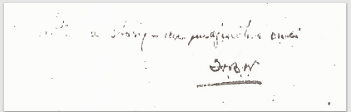
Image of illegible comment with “H.B.W.”, Admiral Wilson’s initials, written beneath it.
Hornblow altered parts of the “Fake Armistice”text to accommodate Admiral Wilson’s and Roy Howard’s criticisms of it. 6 And there were more edits before The Century Magazine published it in November 1921 as “The Amazing Armistice: Inside Story of the Premature Peace Report”. Hornblow changed the title presumably because of Howard’s reasoning that “Inasmuch as the idea of a fake story involves palpable and deliberate intention to deceive, and inasmuch as your article makes clear that there was no such intention on the part of the newspapers or the newspapermen, I feel that your purpose would be better served and an unintentional injustice avoided by the substitution of another term for the word ‘fake’”. (He recommended using ‘false’.) 7
“Amazing Armistice” therefore is the overall result of the changes made to “Fake Armistice”. The copy here is from a 1923 reprint (now in the public domain). 8
THE AMAZING ARMISTICE: INSIDE STORY OF THE PREMATURE PEACE REPORT. ARTHUR HORNBLOW, Jr. [Century Magazine, November, 1921. By permission.]
I quote from the New York Globe of November 8th, 1918:
“French troops resumed their advance along the whole front this a.m.”
To-day’s report of military operations quoted above is the best commentary on the greatest and most cruel hoax in the history of journalism, which yesterday deluded not only New York City but every city and town in the country into a delirium of joy by a spurious report from Paris to the effect that an armistice had been effected between Germany and the Allies and that hostilities had ceased.
It will not be difficult to recall that astounding November 7, when an allegedly unemotional nation indulged in a demonstration of universal and hysterical gladness such as the Parisian boulevards, have yet to equal.
The inside story of how that historic occurrence came to pass has not, I believe, ever been told, due doubtless to the fact that even to this day scarcely a handful of persons are acquainted with the facts. Following immediately after the event, there were a number of erroneous and incomplete explanations in the press, soon lost sight of in the excitement of real armistice days, and never again revived. I feel, therefore, that the lapse of time has served to mellow interest in the affair, and to warrant my somewhat retrospective narrative. Perhaps what I am able to tell has actually some proper place in the voluminous history of America’s war-time.
I trust I may be pardoned a brief explanation of my humble place in the proceedings. For a few months prior to November 7, 1918, I had been the army intelligence officer of the military port area based on Brest.
My duties, in addition to the major one of conducting counter-espionage activities within the base, called for the reception and care of newspaper correspondents who came to Brest. The reason for this attention was principally one of courtesy, for, although the intelligence section of the general staff is charged by army regulations with the supervision of war correspondents, the base intelligence officers had nothing to do with the censoring of press reports. This task was cared for by a special censorship branch of the intelligence section, having officers at Chaumont and Paris, and it is important to bear in mind that although Brest is the seat of the French cables and the despatching-point of all messages to the States, no message of importance could pass by its local censor that had not been approved by the Paris censors.
When, therefore, shortly after the arrival of the rapide [sic] from Paris at nine o’clock on the morning of November 7, Roy W. Howard’s entrance into Brest was signaled by my gare control1, I expected to see him shortly thereafter. Most newspaper men made a point of reporting promptly at the office of the local “I.O.” in order to hear if any news had broken locally, and to be facilitated generally in getting around and seeing things and people.
I had heard of, but had never met, Howard. I knew him to be president of the United Press, an important news association which serves a host of papers all over the world, principally in America. Furthermore, intelligence instructions as to the status of all correspondents in France which included their standing in the profession and the degree of attention to which they were entitled wherever they went, graded Howard among the highest. Hence I looked forward to the call of some one who approached the exalted ranking of “distinguished visitor”, a class of ambulatory and privileged beings who, having shaken hands with the commander-in-chief, frequently felt justified in emulating the manners of a German top-sergeant by demanding the attention and services of any junior officer.
________________
1 Intelligence operators in civilian clothes posted at all important railroad depots to report the arrival of any one who might interest the “I.O.”
Section 2
It was accordingly a matter for surprise and gratification when Howard strolled in casually shortly before noon and disclosed himself to be what we in the army were wont to call a “regular guy”. (There is no higher form of decoration in the army short of the Congressional Medal.) Still in his early thirties – or seemingly so – Howard was the typical newspaper man, genial, natural in manner, and alert. Slight of build, with something of the college boy still lurking behind his little brush mustache, and with a breezy manner that dispelled formality, Howard perched on the edge of my desk and in very short order made me glad he had come.
He immediately laid the groundwork for the historic occurrence that was to take place within a few hours by his expressed desire to effect a change in the transportation plans that had been made for him in Paris.
“I’m due to sail at two this afternoon on some ark that takes two weeks getting home,” he lamented. “I’d like to make better speed if possible. Want to catch President Wilson in time to come over here again in his party.”
The man knew even then that the President was coming! I sensed something of what goes to make the successful newspaper man.
By telephone I learned that the S.S. Leviathan was due to sail the following morning. As she made the trip across in six days or so, Howard could save a week by waiting a day. Accordingly, arrangements were made to shift him from the sailing-list of the one ship to that of the other.
That done, we discussed ways and means of his killing time advantageously, and Howard, inspired by some mischievous fate, decided that he would like to meet Admiral Henry B. Wilson, commander of the American navy in French waters, whose headquarters were in Brest.
I suggested strolling around to naval headquarters which were near by, and we left my office at about noon, it then being not quite seven a.m. in the land across the sea that little suspected what had started to brew for it.
As we turned from the Rue du Chateau into the old public square, Place du Président Wilson, we paused before the office of Brest’s daily newspaper, “La Depeche,” to examine the bulletin and saw that the Germans had evinced a desire to quit and that their plenipotentiaries were reported to be coming across the lines to sue for an armistice. A small, excited crowd was discussing the tidings and waiting eagerly around for more. Oddly enough, a rumor was seeping through it to the effect that an armistice had already been signed, and Howard told me that he had heard the same thing when he came in at the station that morning.
The sight of “La Depeche” office inspired Howard to pay it a visit, due to his company having relations with it that I was soon to hear about. We walked inside and stopped at the telegraph room, which was nearest the door, and Howard entered animatedly into conversation with the operator on duty in a French that was as utilitarian as it was full of gestures. I gradually gathered a fact that was to have tremendous bearing later on.
It seems that, apart from our own signal lines, there were only two ways of communicating by telegraph between Paris and Brest. One was by the regular wires of the public telegraph service; the other was by the private wire of “La Depeche”. Users of the public service – and this included correspondents sending their communications through to be cabled to the States from Brest – had to wait their turn, a matter usually of several hours, and the United Press had scored a brilliant “beat” by getting the permission of “La Depeche” to share its special wire, thereby avoiding delays in transmission to Brest and being able to gain the cables ahead of its competitors.
Thus, the system by which United Press communications went through from Paris was as follows: first, it would pass through the necessary censorship, then it would be put on the private “Depeche” wire and sent to Brest. It is highly important to note that the receiving-instrument in “La Depeche” office was of the ticker-tape variety commonly used throughout France, being a machine which typewrites its own messages on paper ribbon. When the United Press communications were ticked off in “La Depeche” office by the sending operator in Paris, the tape recording the message was cut up, pasted onto the usual telegraph form, sent by messenger across the place to the post-and-telegraph office, and filed for the cables. Long practice had accustomed the Brest cable censors to recognise these United Press messages, and, in view of their having already been censored in Paris, to accord them prompt transmission without further censoring. As will be seen, this habitual treatment of Paris-“Depeche” telegrams had great bearing on, and is largely accountable for, what is to follow.
After Howard had given enthusiastic greetings and remerciements to everbody on “La Depeche” staff, we went along to naval headquarters. I thought that Howard would be able to see the admiral at once, as the latter was almost always in his office and exceedingly easy to “get to”. He was one of that small but eminently successful group of service executives who, despite the stature of their war tasks, seemed always able to see any one – and for any length of time. Admiral Wilson was at the time directing all transport and fighting activities in French waters, which included, of course, the delicate destroyer operations against enemy submarines and the command of all naval personnel in France. His was a job of enormous responsibility and required an inordinate amount of wakeful attention. But there was about him at no time any of that suggestion of rush and over-exertion common to the smaller man with far fewer cares. The navy knew that the meanest-grade fireman could reach the Admiral’s ear as easily as a congressman, perhaps easier.
But fate was still having its bizarre way. The admiral was out, and his aide, Ensign Sellards, made an appointment with Howard for four o’clock that afternoon. On such slender threads as this does history hang! Had the admiral been in when we called and Howard had spent a half hour or so with him at that time instead of later in the day, the famous armistice celebration of November 7 would never have occurred.
By the time I had shown Howard a few of Brest’s sights (nothing much to see) and we had lunched at the Navy Club, it was after two o’clock. I took him then back to his hostelry, the Continental, where he had been lucky enough to find quarters, the place being packed to the roof with congressional “visiting committees,” known unpleasantly in the army as “joy riders”, Y.M.C.A. workers, French demi-mondaines, hordes of quartermaster Corps officers and naval paymasters, a few stray doughboys on special pass, an assortment of “Swiss” salesmen of considerable interest to my department, and, an occasional, very occasional, Frenchman bearing an apologetic air for seeming to intrude on so happy an American family. Then, having my day’s work still before me, I left, cautioning Howard to be punctual at the naval office if he craved the Admiral’s love and respect.
Section Three
At four-thirty, or thereabouts, as I sat at my desk mulling over some reports I heard a great shout go up somewhere in the general direction of the Place du Président Wilson. Exuberant behaviour of all sorts being more the rule than the exception in the Yankee-burdened Brest of those exciting days, I paid no attention to the racket; but shortly afterward one of my men entered with the report that official news had been given out to the effect that an armistice had been signed and the fighting had ended at the front. Had been given out, what more, by naval headquarters!
Astounded at the suddenness with which truth had been given to the odd rumor that had hovered over Brest all day, I started inquiries that quickly disclosed what had occurred. It was not for some time that I located Howard, who, with Major Cook of General Harries’s staff, was going from one official bureau to another in his endeavor to procure additional information. From him I learned that the armistice tidings had been pronounced official by Admiral Wilson and that Howard had sent a cable to the United States saying that the war was over.
If the news was true, Howard probably had scored the biggest news beat in history. And from Howard’s recital of the facts there seemed to be no question of the news being authentic. Back in my office, he told me what had happened, beginning by tossing on my desk a copy of his message to the States. It was addressed to the United Press office in New York City and read:
“Urgent. Armistice allies Germans signed 11 smorning hostilities ceased two safternoon.”
It was signed “Howard-Simms”. Simms was the United Press man in Paris. Apparently Howard wanted to let him share the glory of his “beat”. Where and how the latter had arisen so suddenly in Brest, several hundred miles from the front, I could not imagine. I looked up wonderingly and heard the story.
Promptly at four o’clock Howard had been presented to Admiral Wilson. They had been chatting awhile when the admiral remarked that he had just received a message which might possibly interest Howard, and handed it to him for his perusal. Howard beheld an official telegram signed by Commander Jackson of Admiral Wilson’s office in Paris and naval attache at our Paris embassy. It said:
“Armistice signed this morning at 11 all hostilities ceased at 2 p.m. to-day.”
Howard was amazed. So the war had ended! Rather suddenly, perhaps, but none the less surely. There could not possibly be any doubt about it. Any question as to the authenticity of the report that might have arisen in the minds of the two men was justifiably dismissed by a consideration of the telegram’s source. Naval officials are scarcely given to making so flatly the report of a highly important fact unless it is based on truth; much less so to the commanding naval officer in France, whose receipt thereof might entitle him to believe that submarine warfare had likewise terminated and that his destroyers might relax their vigilance. It was incredible that, however surprising, the message might be fallacious.
No other official source, French or American, appeared to have the great news, and, desirous that the people of Brest learn of it, Admiral Wilson despatched an orderly to bulletin the tidings in the public square, where the naval band happened to be giving its weekly concert.
The tiny spark of news set a flame that within ten minutes had spread like a prairie fire from one end of Brest to the other. Into the streets pressed the people, stunned at first, literally dazed by the victory that had come to France, then gradually opening up into a mad rejoicing as the tragic repression of four terrible years rolled from their hearts. As Howard spoke, the crowds surged outside my windows, laughing, screaming, sobbing, singing. They celebrated, yes, but it was a different sort of celebration to the gay-hearted, happy holiday and mad-cap carnival into which, thanks to Howard’s cable, America was at that very minute plunging.
“My cable will get there in time to catch the afternoon editions,” reckoned Howard, measuring the difference in time on his fingers. “There’s a day in history for you.” Actually the news flashed from Brest to New York in six minutes flat, thereby making special noon editions!
Howard had done what any other skilled newspaper man would have done under similar circumstances. He had seen the opportunity of his life-time – of any war correspondent’s life-time. Here he was at Brest, the cable point, with hot news just off the official griddle that apparently no one else had, that perhaps had not even yet been given to the press in Paris. He could beat every competitor in the business on the biggest news break in history! He could get his message to the States in time for the afternoon editions. The others might not get there until morning.
Admiral Wilson expressed his willingness that Howard should use the report. In company, therefore, with Ensign Sellards to assist him in arranging things Howard rushed to the postes. But desiring to file a typewritten message so there would be no possible misunderstanding or misreading by the French cable operator Howard dived en route into the nearby telegraph room of the “La Depeche” and demanded a type-writer, explaining hurriedly his reason.
By a further coincidence, the telegraph editor undertook to type out Howard’s message, and used his own telegraph instrument to do so, it being possible to type on the ribbon with the local telegraph key as well as with the transmitting-key in Paris.
Then tearing off the tape, the obliging Frenchman pasted it as usual on a telegraphic form, and, lo! the message was clear and ready for immediate filing. What is vastly more important, it looked exactly as though it had been transmitted from Paris as were all other United Press messages and had been censored there!
Section Four
Looking at it in the light of later reflection, I am convinced that it was this unintended strategy of Howard’s that enabled him to get his cable past the local censors. I say “unintended” because it is inconceivable that in the circumstances any man, however alert, could have thought-up so extraordinarily clever a devise. Knowing that type of French official as I do, I am convinced that no one in Brest, of whatever exalted rank, could have caused the local French censors to let by so portentous a message without having the O.K. of either the Ministry of War or the Paris censorship office.
I am further convinced that it was the strange combination of circumstances that led to the message’s looking as if it came from Paris. It was even signed, thanks to Howard’s generosity, by Simms, the man who signed all the messages that came from Paris and with whose name the Brest censors were familiar as being the stamp of proper procedure. That resulted in its speedy transmission to America’s noon editions! And in New York the censor, justifiably concluding that the Brest censor would not have passed so important a piece of news unless it had been first passed by the Paris censor, fell victim to the same fluke and the damage was done. The general belief that the message had, in fact, come from Paris is further verified by the short extract from the New York “Globe” given above in which it is stated that the spurious report emanated “from Paris.”
It is an extraordinary fact that probably, in view of the above facts, Roy W. Howard was the only man in the world who could have sent the message as it was sent or who could have sent it all. As president of the United Press and in close touch with “La Depeche”, he possessed both the authority and the machinery wherewith to “put the thing across.” That he was actually in Brest on that day and in consultation with Admiral Wilson is a coincidence that staggers the imagination.
Torn between believing and not believing, wanting to be as exultant as the throngs that were sending their songs up to us from the crowded, narrow streets, I was perturbed principally by the silence on the subject of an armistice that my own department had maintained. It seemed impossible that, if the news were true, I would myself not be advised by intelligence headquarters, in order that I might inform the commanding general of the base.
I called the Paris intelligence office by telephone and, to their apparent astonishment, explained what had occurred. No word of any armistice had reached it; nothing more than that enemy plenipotentiaries were expected to meet Marshal Foch that afternoon at five. I requested the Paris “I.O.” to get into immediate touch with the French Ministry of War and advise me of consequences as soon as possible.
But seeming set-back [sic] did not serve to shake Howard’s confidence. On the contrary it indicated to him that his “beat” was all the bigger. He protested that the news was probably just out, and that the Paris embassy had received it before the “I.O.,” a perfectly possible occurrence. And always present was the incredibility of Admiral Wilson’s office in Paris imparting such news to him unless it were true. There had been neither uncertainty nor doubt in its words. The armistice “signed,” all hostilities “ceased”; nothing equivocal about such expressions as those.
During our luncheon and before the storm had broken, Howard had asked me to dine with him that night, little thinking that he was, in effect, asking me to an “armistice celebration.” There was to be no official army celebration of the “victory”, inasmuch as General Harries, after telephoning me to ask whether I had had confirmation of the report from Paris or Chaumont, declared that he would refuse to believe it until I did.
At Howard’s request I had earlier in the day rounded up a small band of cronies, and six of us gathered around the tiny table that our host had managed to engage at La Brasserie de la Marine, Brest’s Delmonico, and, that evening, a pandemonium of gaiety.
It need hardly be said that some spirit of that same unrestrained emotion that was sweeping through our own home towns at that minute animated our little group. The war over! It seemed impossibly, wonderfully true. Only a few weeks back it seemed as though it would never end. And here it was – “fini la guerre!” The famous doughboy phrase rang out on all sides. Through the windows poured the din of rejoicing in the streets. The brasserie was alive with flags, confetti and streamers that had leaped suddenly into being from nowhere, and the usual clatter of dishes was replaced by the yells and songs of several hundred unrestrained throats.
Two pretty girls danced recklessly on a narrow table packed tightly against ours, while their Yankee escorts roared a jazz accompaniment. An orchestra played in a far corner – played madly, furiously, but no one heard it. A drunken sailor climbed up on the chandelier, fell off; the world shrieked with laughter. A near-by French officer, turned martial by Moet, ‘cent quatre, exhorted a deaf multitude not to stop the war, and finally fell to weeping on the table-cloth. Everywhere noise, din, madness, a universe gone drunk with a wine that knew no grape. Then came, as it had to come, born at the same instant out of an [sic] hundred mouths, “La Marseillaise.” I can hear it still, that “Marseillaise,” twining around my heart like some divine hand, lifting it up and up.
Section Five
Then suddenly came the crash, just as it had to come, out of a sky that was blue and beautiful, out of a sky the horizon clouds of which I had come near to forgetting. I had left word for any wire from Paris to be sent to me immediately. In the midst of a din that was getting louder momentarily, a signal corps orderly entered the room unnoticed and made for our table. A feeling of chilling apprehension seized me as I grasped and opened the message that was handed to me. I felt Howard’s eye on me as I read, and the blood marched to my head.
The communication was in intelligence code, and the process of translation was slow and fearful. Finally it was done. I had only to read it aloud to that screaming mob about me to be torn to little pieces. The message said:
“Armistice report untrue. War Ministry issues absolute denial and declares enemy plenipotentiaries to be still on way through lines. Cannot meet Foch until evening. Wire full details of local hoax immediately.”
The message was signed by Major Robertson, my immediate superior at Paris.
I shall draw a swift curtain over the cruel scene of reaction: Howard’s white, drawn face as he realized what he had done, as he read in the words I handed him his own doom and that of the United Press; our filing out with him back to the Continental, leaving behind us, undisillusioned, the tragically joyous throngs celebrating a peace that was not a peace – a peace whose morning after would find men still killing one another monotonously, hopelessly, as had every dawn since August 1914.
A revival of hope, an inability to believe even Robertson’s definite words, impelled Howard to go in search of Admiral Wilson. The two of us finally located him dining en famille with a French local official, and in answer to the inquiries we sent inside, Ensign Sellards came out to tell us that the admiral had heard from Paris that the news he had received that afternoon concerning an armistice had been “premature.” Clinging to the faint belief that “premature” meant “true, but not properly released,” Howard spent most of the night trying to get information from his own Paris office. When that came, all hope crashed to the ground. “Premature” meant untrue. The world collapsed about Howard’s ears. The biggest “beat” in the history of journalism had turned cruelly into its biggest “bloomer”.
The blackest of black skies cleared considerably for Howard the following morning, when Admiral Wilson, every inch the gentleman and the man, took upon his own shoulders complete responsibility for Howard’s fateful cable. In the admiral’s statement, issued at once to the press, he did not even make mention of the official who had sent, or, at least, whose signature was affixed to the erroneous communication from Paris. To the latter he referred simply as “what appeared to be official and authoritative information”.
The career of a lesser man might very well have been marred by this brave assumption of blame, but, then, a lesser man would probably not have made it. Not long after the closing of war-days, Admiral Wilson was placed in command of the Atlantic fleet, and just recently has been made commandant of the Naval Academy at Annapolis. So it is seen that he has not suffered in consequence of his courageous protection of Howard, whose journalistic fate, without that protection, would unquestionably have been a severe one.
As it is, it will be remembered that the American press railed against the alleged hoax and called loudly for those responsible to be brought to book. Branded as “either one of the most colossal fakes in history or an inconceivably bad blunder”, the newspapers throughout the country dwelt principally on the cruel disappointment to the American people and “especially those having husbands, sons, fathers, and brothers in the bitter fighting at the front.” Much emphasis was laid editorially on the fabulous cost of the “fake” to the country, a total running into uncomputable millions and resulting primarily from the fact that work was “knocked off” at noon in virtually every office and plant from coast to coast and not resumed until the following day. The bill for street-cleaning after the celebration in the larger cities presented in itself a staggering total. One New York paper declared that New York’s own bill of eighty-five thousand dollars should be presented to Howard for payment!
Section Six
But if the Wilson statement exonerated Howard, as it did and as it should have done, for in my opinion he was somewhat less responsible for the false armistice celebration than the American newspapers who printed his cable as absolute truth despite other conflicting despatches they were in receipt of at the time, who was to blame?
It is said that the wire signed by Commander Jackson was based on information telephoned to the American embassy by a person who purported to be speaking officially from the French Ministry of War. Thus in a way we find ourselves face to face with an object of ultimate blame that is as mysterious as it is unknown, for subsequent investigation showed that no one at the ministry had called the embassy that day. There is a possibility of course, that the embassy’s anonymous informant was nothing else than a practical joker. This, however, is scarcely credible. Some other motivating force may very properly be looked for than the mere desire to jest.
I realize that I may regard the matter through spectacles somewhat tinted by many months of service in the counter-espionage section of the army, but, for reasons which I shall expound, it is my belief that the naval office in Paris, Admiral Wilson, Roy Howard, and the entire United States of America were the victims of one or more secret agent of the German Espionage Corps.
It will be recalled that, on the morning of November 7, enemy plenipotentiaries were reported to be coming through the lines to sue for an armistice. It being a principle of the German intelligence system that “fixed operators” – namely spies on permanent duty at one point – work actively on their own initiative and without orders, taking into consideration the news and needs of the day, it is reasonable to suppose that an intelligent enemy agent in Paris would set about doing his utmost on November 7 to create popular desire and demand among the Allied people for the German-sought armistice.
The existence of such an attitude on the part of the people would make for a more certain and swifter cessation of hostilities and an avoidance of the terrible smashing blows that German arms and Germany seemed doomed to receive. From a psychological and somewhat typically German point of view the best possible way of making the public want an armistice would be to tell them that there was an armistice, and let them taste of the joy that would naturally await upon the news.
Had the American people not been rewarded with a real termination of the struggle a short time after their wild celebration of the supposed [sic], it must be believed that the reaction of their disappointment would have been both severe and dangerous to home morale. The “Globe” quotes a prominent citizen as saying on November 7, “It will be a tragedy if this report proves untrue.”
A similar effort to stampede the French press into announcing an armistice appears also to have been made. It was impossible, of course, to fool Paris, but St. Nazaire received the rumor, as did Bordeaux, Marseilles, Nice, Lorient, and other French points. It was present in Brest before Admiral Wilson’s receipt of the message from Paris. London had it, but its press was highly conservative in passing judgment on its credibility, and, with one unimportant exception, did not announce it to the people. Holland and parts of Belgium had it. Possibly, too, many other localities; but I have named all that I know about save Mexico and parts of South America, where the celebration was hilarious, but more probably on the strength of the United Press report. Holland’s having the “news” is strongly suggestive of enemy espionage effort.
Thus it would appear that an organized attempt was made to make the Allied people cherish an armistice which, though not yet existent, was within easy reach if the people wanted it and showed clearly that they wanted it. I should greatly like to see the intelligence reports of our late enemy for November 7, 1918. The scheme is worthy of the German service in both ingenuity and execution, and does credit to the one or more persons who conceived it.
Who knows but what it may have had something to do with accomplishing their purpose? President Wilson cast his important decision for an armistice after he had witnessed the demonstrations of November 7, reliable proof of the country’s sentiment, and it is said that Wilsonian pressure was largely, if not entirely, accountable for the granting of an armistice at a time when French and Allied military leaders were preparing to administer to Germany the terrific smashing for which they had built up and to which they were looking forward eagerly, exultantly.
Who knows but what a still fight-hearted American people might not have cried loudly for “On to Berlin!” had not the sweet branch of the olive tree been placed prematurely in their hands and found to be much, very much, to their liking? [END]
Omitted from “Amazing Armistice” are the “Fake Armistice” references to Hornblow’s superiors in G-2 (SOS); the identities of the other officers who joined him and Howard for dinner at La Brasserie de la Marine; and the line “Y.M.C.A. entertainers, mostly long-haired men and short-haired women”. (“Fake Armistice” pages 2, 7, and 12).
Several passages are essentially unchanged, some most likely indicating Hornblow’s beliefs about what had occurred in Brest on 7 November 1918. For instance, his explanation of the agreement the United Press office in Paris had with La Dépêche de Brest for its use of the newspaper’s private telegraph line from Paris, and its significant advantages for the news agency. “Amazing Armistice” publicised this information (whose accuracy was not disputed); and plainly reveals that Hornblow had decided the agreement was the fundamental reason Howard’s armistice cablegram went unhindered and uncensored to New York City – “this habitual treatment of Paris-‘Depeche’ telegrams had great bearing on and is largely accountable for [it]”. (“Fake Armistice” pages 5-6; “Amazing Armistice” section two.)
Also, on the important related issue of whether Admiral Wilson helped Howard “in getting his message past the local French censor” (“Fake Armistice” page 10 ), Hornblow was convinced that “not even . . . Admiral [Wilson] in person” (“Fake Armistice” page 11 ), changed to “no one in Brest, of whatever exalted rank” (“Amazing Armistice” section four) could have induced the censors to transmit Howard’s armistice cablegram if they thought its message had not been verified already in Paris. An uncompromising statement, which may be seen as Hornblow’s rejection of insinuations Howard was making by 1921 about the Admiral, but one that ultimately failed to discredit and silence them. (Hornblow did not have the last word on the matter.)
Readers could reasonably deduce from all this that Howard had rushed straight to the La Dépêche building with Admiral Wilson’s armistice news, fully intending to have it put together there so that it looked like a telegram from the United Press office in Paris when it went to the Brest Post and Telegraph Office. For this reason no doubt, Hornblow commented that “looking at it in the light of later reflection”, it was just a happenstance: an “unintended strategy of Howard’s that enabled him to get his cable past the local censors”; and “inconceivable that in the circumstances any man . . . could have thought-up so extraordinarily clever a devise [sic]”. (“Amazing Armistice section four; with slight changes from “Fake Armistice page 11.) Howard did not refer to this passage in his criticisms of “Fake Armistice”; but in his 1936 memoir, he explained his armistice cablegram along similar lines: “The impossible had happened. A fantastic set of circumstances which could not have been conceived of in advance combined unintentionally and unwittingly to circumvent . . . [a] censorship which no amount of strategy and planning had ever beaten”. 9
Regarding the spread of the 7 November news outside France, Hornblow (like more recent writers) was completely wrong in stating that the British press did not announce the news. Roy Howard seems to have known about a “Reuters dispatch” in London linked to the spread of the news – he named it (without elaborating) in his 1921 letter to Hornblow about “Fake Armistice” (p5). 7 He may also have known from the United Press office in London that the US Embassy there leaked the news; but he did not give Hornblow the information. Not surprisingly, American reviews of “Amazing Armistice” gave particular attention to Hornblow’s (entirely speculative) German-spies-in-Paris theory of its origins. Howard later adopted this (without acknowledgment), changed some of its details, and, like Hornblow, used it to bring his 1936 false armistice memoir to an end. 10
Hornblow’s fortuitous information about the Jackson False Armistice Telegram
In “Amazing Armistice”, Hornblow had been the first to state publicly that Captain R. H. Jackson, the US Naval Attaché in Paris, was responsible for sending the 7 November 1918 armistice message to Admiral Wilson in Brest.
The message Jackson purportedly sent was an ‘afternoon false armistice report’, wired a few hours after similar morning reports in Paris. It stated that the French Foreign Office had announced a German-Armistice signing at 11:00 am, a cessation of hostilities at 2:00 pm, and the US Army’s taking of Sedan that morning. It showed “15207” – 3:20 pm on 7 November – as the transmission time, and “Jackson” as having authorized it.
Moses Cook’s 1941 and 1944 letters about the telegram
In April and May 1941, by which time Hornblow was an established Hollywood film producer working at Paramount Pictures, he received information about how the Thursday 7 November 1918 armistice news reached US Navy Headquarters in Paris and was transmitted to Brest. It came, unsolicited initially, in letters from Moses Cook, “a press telegrapher in civil life” but then serving as a radio operator with the rank of Chief Petty Officer on the USS Wyoming.
“I . . . sent it originally from Naval Headquarters in Paris”
In April 1941, in the first of four letters to Hornblow, Cook claimed that he had been the duty “chief radioman” at the US Navy Headquarters that afternoon; and without elaborating stated (ambiguously) that he was “the one who sent [the news] originally from Naval Headquarters in Paris”. As verification, he included a clipping about a Columbia Broadcasting System (CBS) twentieth-anniversary Armistice programme from New York City in November 1938, during which he “told his unique story”, to radio journalist Gabriel Heatter, “of the tense moments when the [false armistice] news was received and how it was cancelled later”. (He did not at first refer to Captain Jackson or the American Embassy.) 11
He had contacted Hornblow, he explained, to request a copy of his November 1921 “Amazing Armistice” to replace one in his collection of “stories relative to this Armistice” which a friend of his (Col. W.H. Rankin) had borrowed while writing a book about Roy Howard but then mislaid.
In his replies to this and Cook’s subsequent letters, Hornblow promised to try to find a copy of the article, and pressed him for particulars about what had occurred. He asked for a “recital of . . . facts” about how the “[armistice] telegram was filed with [him] and by whom”; “most particularly”, whether Captain Jackson “had anything to do with [it]”; whether the Embassy had tried “to account for the filing of the wire”; who the officer was who ordered it and why he believed it was authentic; whether “he was an officer of the regular navy or the Reserve; and whether Cook saw him again. Fundamental questions whose answers might dispel some of the mystery surrounding the False Armistice.
The following recounts what Cook recalled, and contains extracts from a newspaper item he also sent to Hornblow.
“Very glad to . . . pass along the story of the ‘False Armistice’ to you as it really happened.”
Cook remarked that, apart from himself, only two other people “knew this story”: “a successful attorney in New York City”, whom he did not name; and “Lieutenant Junior Grade Barler”, Navy Reserve, from Michigan, whose initials he did not recall, and who had died in 1934.
On 7 November 1918, Cook was the “chief radioman in charge of the wire room” [Naval Communication area] at US Navy Headquarters in Paris; Lieutenant Barler was the duty “communication officer”. During the afternoon [no time specified], Barler suddenly rushed into the wire room, handed Cook the message “Armistice signed eleven am, cease firing two pm, Sedan capitulated“, with Captain Jackson’s name on it, and told him “Get this off right away”.
Cook asked the Lieutenant where it had come from; Barler replied that a commander at the Embassy had just telephoned it to him and mentioned his name to Cook (who remembered the commander but not his name). Cook then passed the message to the “operator who was sitting on the Brest Wire” (unnamed), who stopped what he was doing (“sending the American casualty list of the killed and wounded as we did every afternoon”) and forwarded the armistice bulletin straight away.
Some twenty minutes later, Barler rushed back and shouted to Cook “For Gods sake stop that message . . . . Its a fake”. Cook pushed the operator away from the transmitter, “grabbed the key and asked Brest if they could stop the message”. But it was too late – “Brest told [him] it had gone to Washington long ago”.
Cook pointed out that as well as being American Naval Attaché in Paris, Captain Jackson was Commanding Officer at Navy Headquarters. He was “very certain that [Jackson] knew nothing about this message” and did not authorize it even though his name was attached to it: “all messages leaving our headquarters had to be signed ‘Jackson’ as a matter of routine, but he did not see every dispatch that was sent”. Indeed, “he was very much upset about it”, demanded to know what had happened and who had released it, and had Lieutenant Barler “on the carpet about it”.
Just prior to Cook’s participation in the November 1938 CBS Armistice anniversary programme, CBS asked Jackson, by now an admiral, for permission to name him in connection with the False Armistice. He emphatically refused, threatening to “bring suit” against CBS if they did. Consequently, the programme referred to him only by his title of naval attaché. “I am very certain”, Cook maintained, “that he knew nothing about this message”.
Cook was convinced that Lieutenant Barler was duped into thinking the call was from the Embassy when it was “probably the work of an enemy agent” aiming “to give the world a taste of what an Armistice was like and it seems that they did a good job of it . . . . The fault was with the Lieut. How in the world did he fall for a thing like that over the fone?” He was “sent home”, and Cook did not see him again after 7 November. “He simply believed that the telephone call was genuine”.
Cook’s suspicions were aroused as soon as Barler mentioned the Embassy; and wanted to emphasise that they “never foned that message”, “knew nothing of it, and were never able to locate the party that did . . . . I have never heard of anyone coming forward and saying that they were the one who foned that message to Naval Headquarters”. And why, he wondered, would they “fone such an important message? Why did’nt they put it in code? They coded other messages of less importance, and why was’nt it delivered by a marine courier as were all messages of any urgency? The American Embassy was right behind the Navy Headquarters building. Also I did’nt believe that the Germans had met Foch so soon and to have talked things over so quickly”.
Cook was posted to Italy for a month following the Real Armistice, then to Brest for about seven weeks; here he was “put in charge of the brig” before returning to the United States. Writing again in 1944, by which time he was a warrant officer and “chief radio electrician at the Miami Naval Air station, Opa Locka”, Cook sent Hornblow a cutting about himself from the Miami Daily News with the title ‘Inside Story of False Armistice Flash In 1918 Told By Navy Man Here’. In his interview, Cook repeated what he had related to Hornblow about 7 November events at Paris Navy Headquarters but with an additional conjecture about the origin of the armistice message:
“That will probably always remain a mystery, Cook says. It has been well established that it did not originate in the American embassy. Cook’s own theory is that a clever German agent ‘phoned in the message to the communications system, imitating the voice of [a] commander, who, [Barler] said, dictated [it] to him [from the embassy].”
(Cook’s “own theory” that the peace news was German disinformation echoed what Hornblow had surmised in “Amazing Armistice” and may well have been indebted to it. His proposition that a clever German agent imitated the voice of a commander at the Embassy, thereby fooling Lieutenant Barler at Navy Headquarters, quite possibly struck Hornblow as being obviously contrived and comically implausible.)
In a brief acknowledgment – the last of their correspondence in the archive – Hornblow thanked Cook for the “interesting clippings on [the] Armistice dispatch”. He was “glad to have them” for his files, and to learn that Cook was “still well and active in the service”. (Whether he ever sent Cook a copy of ‘Amazing Armistice’ is not indicated in their correspondence.) 12
Clarifications and related details
Captain R.H. Jackson
Captain Jackson was sent to Paris in June 1917 as the “Representative of the United States Navy Department”, “senior United States Naval Officer on shore in France”, commander of US “naval and aviation bases” in France, and commanding officer at the US Navy Headquarters in Paris. In these capacities, he acted under instructions from Vice-Admiral William S. Sims, the Commander of US Naval Forces in European Waters whose headquarters were in London. He was also Sims’ liaison officer at the French Ministry of Marine in Paris, and was directed to “confer” with Admiral H. B. Wilson at US Navy Headquarters in Brest when (late October 1917) the latter was made “Senior Naval Officer afloat in French Waters”.
In addition to his other responsibilities, in June 1918 Jackson became Naval Attaché and “Liaison Officer between [Admiral Wilson in Brest] and the French Authorities in Paris”. As Wilson’s Liaison Officer, he was considered to be a member of Wilson’s own staff – there was “considerable official and semi-official” daily communication between Brest Navy Headquarters and what Admiral Wilson called his “office in Paris” 13 Moses Cook explained to Hornblow that Jackson was “in command of the US Naval Headquarters in Paris and as such was the American Naval Attache there . . . . He was referred to as Commander at times because he was Commanding Officer, but he was above a Commander”.
Throughout his time in Paris, Jackson’s office was in the US Navy Headquarters building not far from the Embassy. As the new Naval Attaché, his official base and offices were in the Embassy; but he delegated the Assistant Naval Attaché (since October 1917), Lieutenant Commander Charles O. Mass, to carry out his duties there. 14 Cook’s opinion (above) that Captain Jackson did not know about the armistice bulletin before it went out appears to substantiate Admiral Wilson’s 1921 comments to Hornblow that the statement in “Fake Armistice” that the Attaché sent it was “off, though perhaps technically correct . . . . It was from my office in Paris. I hope you see this”. And these comments become clearer if, perhaps, someone in the Naval Attaché’s office in the Embassy sent it to Jackson’s Navy Headquarters office, and someone there, in Jackson’s absence, decided it should go to Brest with his name as authorization. 15
(Lieutenant Commander W. R. Sayles had been the American Naval Attaché since 1915 until his promotion in January 1918 to the new post of “Intelligence Officer of the United States Naval Forces in France”).
Moses Cook
No particulars about Moses Cook’s first and second world war service in the US Navy have so far been located from official military publications. As he was not a commissioned or warrant officer, no ‘Moses Cook, chief radioman’ is shown, for instance, in the 1918, 1919, or 1941 US Navy Lists. The information about him here is solely from the letters and clippings he sent to Arthur Hornblow.
Lieutenant Barler
According to Cook, Lieutenant Barler wrote down the false armistice news telephoned from the American Embassy, ordered its transmission to Brest, and about twenty minutes later tried to cancel it; but by then it had already left Brest for the Navy Department in Washington, DC. Cook avoided naming the Lieutenant in his broadcast, in deference to the wishes of Barler’s sister.
The only Lieutenant Barler listed in the US Navy Register for that time is: “Barler, Harold A.C., Lieutenant (j. g.) [junior grade] U.S.N.R.F., born 18 May 1886, enrolled 23 September 1917”. 16
The unnamed operator of the Brest Wire
Cook stated that Barler died in 1934, leaving just himself and the operator of the Brest Wire as “the only ones that were present” at the transmission of the false armistice dispatch. He noted that he regularly kept in touch with this man, but did not name him, calling him variously “my friend”, “a successful attorney in New York City”, and “a young sailor, now a prominent New York attorney”.
The man was actually Lieutenant Emmett King, who described himself as the “Chief Electrician (Radio)” at Navy Headquarters in Paris. 17 From Internet searches, references to “Emmett King . . . an attorney living in New York” have been located in the transcripts of investigations carried out by the US Senate, following the end of the Second World War, into “Expenditures in the Executive Departments”. Apparently, King took part in a business trip, with two other men, to Paris in July 1945, spoke French, “represented the Albert Verley Co. in New York”, and was advising on the negotiation of contracts with “manufacturers of finished perfumes”. His full name is indexed as “Emmett Miles King”; he was 52 in 1945, and therefore 25 in 1918. 18
In a letter acquired by Roy Howard, King said he knew “what caused the whole [False Armistice] affair”, and had “handled the whole case”. He affirmed that he “flashed the [false armistice] message” on 7 November 1918, but did not specify that he was operating the Brest Wire at the time. He explained that it was “identically the same as the message that was afterwards published in America to the effect that hostilities had ceased”, and that it was given to him “in plain English” at about 3:50 pm (French time). But he did not say where it came from (the American Embassy, French Foreign Ministry, French Ministry of War, for instance) only that it was “absolutely from official channels”; did not reveal whose name it carried as authorization, or to whom and where he “flashed” it. He did disclose that, almost immediately afterwards, it was taken from him and was “never returned to the files”; that “the whole affair” had been caused by a “government official” (not an American) who was responsible for a foolish mistake which could not be made public. 17
US Navy Headquarters in Brest
Apparently, Moses Cook spent seven weeks in Brest before finally leaving France early in 1919. It is reasonable to assume that he became acquainted there with a wireless operator (not identified) at Admiral Wilson’s Headquarters who, L. B. Mickel told Roy Howard, had copied the Jackson Armistice Telegram. And it is possible that Cook also met Lieutenant J. A. Carey, Admiral Wilson’s secretary, who, Hugh Baillie informed Howard, was offering to sell “the original”. Below is the copy of the armistice telegram L. B. Mickel sent to Roy Howard in August 1919. 17
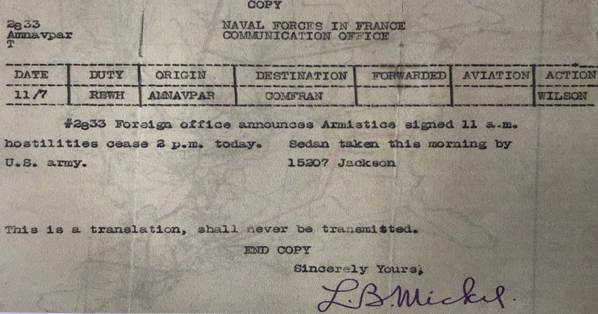
It is not known whether Arthur Hornblow ever saw the Jackson armistice message in its telegram-version.
© James Smith. (Reviewed and with additional material, July 2024. Uploaded, reorganized, reviewed, February 2019-April 2026.)
REFERENCES
ARCHIVE SOURCES
I. Arthur and Leonora Hornblow Papers. Margaret Herrick Library, Academy of Motion Picture Arts and Sciences. Beverly Hills, California.
II. Admiral Henry B. Wilson Papers, Box 1. Archives Branch, Naval History and Heritage Command, Washington, D.C.
ENDNOTES
1. See on this website, “Roy W. Howard in Brest, 7-10 November 1918, Parts One and Two”.
2.The above account of Arthur Hornblow’s military service during the Great War is based on documents contained in the Military File of his private papers, which are located in Archive Sources I above. There are, however, no details in his papers that give an insight into the Intelligence work he carried out or the cases and investigations he may have been involved in. (There is a great deal of information online about his other careers.)
For information about aspects of US Military Intelligence at the time, see Frank J. Rafalko (Ed.), A Counterintelligence Reader, American Revolution to World War II, Volume 1, Chapter 3, ‘Post Civil War to World War I’. (2011). And Roy Talbert, Negative Intelligence: the Army and the American Left, 1917-1941. (2010).
3. Hornblow’s letters to Howard and Wilson requesting their comments on “Fake Armistice”are not in his or their respective archives. The letters’ contents are inferred from Howard’s and Wilson’s responses to “Fake Armistice”.
4. From an undated letter, without an addressee, in the “William Saxe file” of Hornblow Papers.
5. “Fake Armistice” by Arthur Hornblow Jr. Listed as “Monograph, ‘The False Armistice’, undated” in Admiral Wilson Papers. There is no copy of “Fake Armistice” in Hornblow’s own archive or in Howard’s.
6. For details of Wilson’s and Howard’s responses to “Fake Armistice” and Hornblow’s consequent text changes, see “Admiral Henry B. Wilson and Roy Howard’s Armistice Cablegram”under ‘Arthur Hornblow’s “Fake Armistice” article and changes for “Amazing Armistice, 1921”; and “Roy W. Howard in Brest, 7-10 November 1918. Part Two”, under sections comparing information from “Fake Armistice” and “Amazing Armistice”.
7. Roy W. Howard to Arthur Hornblow. San Diego. June nineteenth 1921, p2. Hornblow Papers. Howard was surely right to argue that the 7 November 1918 peace news was false news rather than fake news – both as he understood the terms’ meanings then, and as they are still differentiated today.
8. From, Writing of Today: Models of Journalistic Prose, compiled by J. W. Cunliffe and G. R. Lomer, under Part B. Narrative Articles, pp.67-73. (Third Edition. New York, 1923.) In the public domain since 2019.
9. In “Chapter IV. Premature Armistice – Roy W. Howard Speaking”, of Webb Miller, I Found No Peace: The Journal of a Foreign Correspondent, p84. (London 1936. Special Edition for The Book Club.)
10. See on this website, “Various False Armistice Conspiracy Theories”.
11. First letter: Moses Cook to Arthur Hornblow, 20 April 1941; with a piece about him from The Norfolk Seabag, 2-8-41, under the heading ‘Reserve C.P.O. Had Unique Experience’. (Hornblow Papers)
12. Subsequent correspondence: Arthur Hornblow to Moses Cook, April 28, 1941; Moses Cook to Arthur Hornblow, 7th May, 1941; Arthur Hornblow to Moses Cook, May 14th, 1941; Moses Cook to Arthur Hornblow, May 23, 1941; Moses Cook to Arthur Hornblow (July?) 1944. The latter is not in the collection but is acknowledged in Arthur Hornblow to Moses Cook, 31 July, 1944; its enclosure from The Miami Daily News, 20 June 1944, under the heading ‘Inside Story of False Armistice Flash in 1918 Told by Navy Man Here’ is in the collection. (Hornblow Papers)
13. Admiral Henry B. Wilson to Arthur Hornblow. 13 July 1921, sheet 1. (Hornblow Papers; and p2 in Admiral Wilson Papers.
14. Lieutenant Commander Charles O. Maas compiled A History of the Office of the United States Naval Attaché, American Embassy, Paris, France, during the period embraced by the participation of the United States in the war of 1914-1918, for the US Navy’s Historical Section. Many of the details here about Captain Jackson are from this source. Its unbound typewritten pages are held by the US National Archives and Records Service, Washington, DC. “File Unit, E-9-a, 12302. NAID, 196039947 and 196039948, Container ID 745, Record Group 38”. The separate typewritten pages appeared as a Print Book in 1977. Maas died in France on 21 July 1919 (brief entry about him in the Columbia University Archives, under “Law School, Class Year 1892”), what must have been a short time after he completed the work. In the Register of the Commissioned and Warrant Officers of the United States Navy, U.S. Naval Reserve Force and Marine Corps, January 1, 1919, pp711;1171, he is listed as “Charles Oscar Maas, born 28 Nov. [18]70. Lieut. Commander U.S.N.R.F. Enrolled, 27 Aug. [19]17.”
His History of the Office… is silent about the False Armistice or events in the American Embassy and Navy Headquarters on 7 November 1918.
See also the ‘Richard H. Jackson. (1866-1971)’ entry in “Biographical Details” on this website.
15. See on this website, “Admiral H. B. Wilson and Roy Howard’s Armistice Cablegram”; and “The Jackson Armistice Telegram of 7 November 1918”.
16. Register of the Commissioned and Warrant Officers of the United States Navy, U.S. Naval Reserve Force and Marine Corps, January 1, 1919, p650.
17. See on this website, “Roy Howard’s Search for Information about the False Armistice”.
18. Influence In Government Procurement. Hearings Before The Investigations Subcommittee Of The Committee On Expenditures In The Executive Departments. First Session, pp225, 227, 763. (Washington 1949)

